Automating digital workflows is challenging for many businesses, even after they have invested years in tools, bots, and integrations. The reason is that most workflows are only automated, they’re not intelligent. While the tools automatically execute steps, they often fail to understand intent, context, or outcomes. About 60% of occupations have at least 30% of tasks that are automatable. But few organizations see the full productivity gains they expect because traditional automation struggles with complexity and change. AI agents can help bridge this gap.
In this article, we will see the evolution of digital workflows, why AI agents are transforming them, and what the future holds.
Evolution of Digital Workflows
Traditional digital workflows required people for every task. The manual handoffs, spreadsheets, approval chains, and email threads were the essential parts of early business operations.
As companies grew, this model collapsed as it couldn’t keep up. In its place, rule-based automation and workflow engines took root to standardize processes and reduce human effort.
At first, this shift worked. Simple “if-this-then-that” logic removed repetitive steps and helped teams complete tasks faster.
But as the world of data started emerging and customer expectations started increasing, these rigid workflows didn’t perform well. They could not interpret things, handle exceptions properly, or adjust based on real-time feedback. Every new edge case required another rule, another patch, and another workaround.
Next-gen workflows are no longer linear. A single customer interaction might update the information in CRM systems, billing platforms, support tools, analytics dashboards, and compliance systems in real-time. Rule-based automation struggles here because it assumes predictability, while real business environments are anything but predictable.
This mismatch is why organizations are now moving away from static automation toward systems that can reason, adapt, and act independently.
Reasons Why AI Agents Are Transforming Digital Workflows
AI agents were the main reason that led to the transformation of traditional workflows. They do not blindly execute predefined steps. They observe situations, understand context, make decisions, and take action to achieve a specific outcome.
1. Autonomous Decision-Making Without Micromanagement
Traditional workflows were largely dependent on human oversight because they couldn’t decide what to do when something unexpected happened. But AI agents are way smarter. They address this issue by making their own educated decisions.
For instance, in a finance workflow, an AI agent can automatically approve low-risk kinds of expense requests, flag unusual patterns regarding such expenses, and escalate more complex to a manager. In this way, it becomes easy to cut down delays and minimize the requirement for constant human intervention.
Similarly, in HR, an AI agent can respond to employee questions and requests based on the company’s policies, internal regulations, and procedures. It can provide guidance on topics such as leave, benefits, approvals, or internal processes, while routing more sensitive or exceptional cases to the appropriate HR team member. This reduces the administrative burden on HR and allows the team to focus more on strategic, high-value work.
2. Context Awareness That Mirrors Human Judgment
AI agents don’t treat tasks as discrete events. They are aware of user intent, urgency, historical data, and system dependencies.
Consider a customer service workflow where a complaint is received soon after a payment attempt fails. An AI agent understands the problem, identifies the solution, and reacts appropriately. This degree of context awareness enables workflows to act like experienced employees rather than acting on static systems like ‘if-this-then-that’ models.
3. Real-Time Adaptability in Fast-Moving Environments
Although the vast majority of companies operate in real-time, some of their business processes are not rapid. AI agents are always monitoring inputs and outcomes and making adjustments accordingly when changes arise.
For example, if there is a supply chain operation, an AI system can automatically update customer expectations, alert other stakeholders, redirect stock, and recognize a late delivery. By being flexible and taking necessary actions, small problems will not grow and cause costly failures.
4. End-to-End Orchestration Across Disconnected Systems
Several tools that were never intended to work together are frequently used in modern workflows. AI agents coordinate activities across CRMs, billing platforms, analytics tools, and communication systems, leading to intelligent orchestrators.
An AI agent may automatically schedule onboarding tasks, initiate contract generation, notify finance, and update deal status in the CRM in a sales workflow. As a result, workflows become fluid, connected, and outcome-driven rather than fragile integrations.
5. Reduced Manual Effort Without Losing Control
Workflows powered by AI are often thought to reduce human control. In reality, the opposite occurs. When human judgment is truly needed, AI agents delegate the task to humans. When it is not, they handle repetitive cognitive tasks, idea generation, and decision-making.
For example, agents can investigate a document, validate data integrity, and assess potential risks in sectors, but human experts still have the final say over approvals. This balance reduces workload without compromising trust or accountability.
6. Faster Execution at Scale
Speed becomes a competitive advantage when workflows scale without friction. AI agents operate continuously, managing thousands of tasks in parallel without fatigue or performance drops.
This is especially powerful in voice-based workflows. Businesses can build fast and multilingual voice agents at scale. This makes real-time voice-driven workflows practical, responsive, and globally scalable without heavy infrastructure or staffing costs.
7. Continuous Optimization Instead of Periodic Improvements
Traditional methods can only be improved after manual redesigns by teams. This usually happens after several months. Unlike this, AI agents learn constantly based on the results obtained.
AI Agents point out areas of inefficiency and optimize the process of execution in real-time. With continuous improvement, the process tends to become quicker, more accurate, and more resilient in the natural workflow.
8. Stronger Governance and Built-In Accountability
AI agents provide governance and security by incorporating policies, compliance rules, and audit logic into their workflows. Every decision gets recorded somewhere, every action has a traceable flow, and everything is maintained in an explainable manner. This is an essential requirement when it comes to the finance, health, or telecommunication sectors.
This intelligence becomes visible in customer service processes through tools like Nextiva AI receptionist. For instance, a business employs AI agents to interpret caller intent and avoid missing any inquiries. This results in smoother operations, faster response times, and a great first impression that is always professional. This is all done without hiring more human resources and incurring operational complexities.
4 Use Cases of AI Agents in Next-Gen Digital Workflows
These real-world AI use cases show how AI agents are redefining workflows by making them faster, smarter, and adaptive across modern business operations.
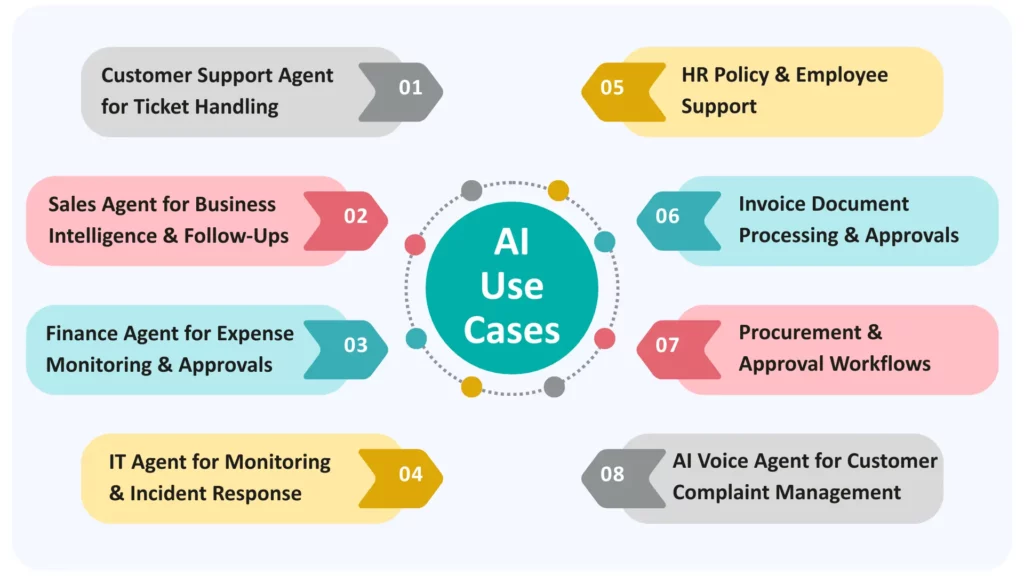 1. Customer Support Workflows
Tickets are routed using keywords and priority tags in traditional support workflows, which frequently results in incorrect classification, longer wait times, and frustrated clients. AI agents change this by instantly comprehending customer history, intent, and sentiment.
An incoming message can be read by a support AI agent, which can then determine whether to auto-resolve, respond right away, or transfer it to a human. It also determines whether the customer has previously interacted. Over time, the workflow improves itself by learning which resolutions lead to faster satisfaction, reducing repeat tickets and agent burnout.
2. Sales Operations Workflows
As the buying signals are dispersed throughout emails, CRM notes, call transcripts, and website behavior, sales teams frequently overlook opportunities. AI agents combine these signals into a single workflow for making decisions.
For example, an AI agent can automatically prioritize a lead, alert the sales representative, create follow-up content, and update deal probability when a prospect revisits pricing pages, opens proposal emails, and mentions urgency in a call. This creates revenue-driven and proactive workflows.
3. Finance and Accounting Workflows
Manual financial workflow relies heavily on human verification. This slows down processes and creates a potential for human error. AI agents verify invoices and flag anomalies before automatically enforcing approval requirements.
Agents immediately mark spending behavior based on past trends or policy thresholds. Only exceptions need human intervention; routine transactions proceed automatically. This strengthens compliance, speeds up processing, and increases accuracy without hiring more employees.
4. IT Operations Workflows
In traditional IT workflows, alerts trigger tickets, tickets trigger investigations, and teams react after issues impact users. AI agents flip this model.
An AI agent can monitor logs, performance metrics, and user behavior. It can even detect early signs of failure and take actions automatically to achieve a result. It takes actions such as reallocating resources or restarting services. If human intervention is needed, the agent provides context instead of raw alerts. This reduces downtime.
Future of AI-Driven Digital Workflows
Autonomous Operations at Scale
AI-driven workflows will become end-to-end automated. There will be less human involvement. This will allow organizations to focus on complex processes automatically while humans focus on strategic decisions, exceptions, and creative problem-solving.
Collaborative AI Agent Ecosystems
Traditionally, automation tools operated as a single machine. But now multiple AI agents will work together. Each AI agent will specialize in a specific domain. They will share insights and context. This will enable workflows to adapt dynamically across teams, systems, and business functions.
Built-In Continuous Optimization
Workflow improvement will no longer rely on periodic reviews. AI agents will continuously analyze performance, learn from outcomes, and refine execution paths automatically. They will improve speed, accuracy, and efficiency in real-time.
Predictive and Preventive Intelligence
AI agents will predict failures, bottlenecks, or inefficiencies in the process. They will accomplish this by identifying patterns in the process early on. This will enable workflows to self-adjust and maintain operational stability.
Improved Productivity and Efficiency Gains
As more AI-driven workflows emerge, they will replace traditional automation in terms of speed and quality of output. One of the key findings from a recent DORA report says that more than 80% of respondents showed that AI has improved their level of productivity.
Start Building Intelligent Workflows With AI Agents
AI agents are redefining digital workflows by bringing intelligence, adaptability, and autonomy into everyday operations. Unlike traditional automation, they execute tasks, understand context, make decisions, and continuously optimize how work flows across systems and teams.
For businesses, this means faster execution, reduced manual effort, stronger governance, and workflows that scale without complexity. If you’re looking to move beyond rigid automation and build truly intelligent, next-generation workflows, Comidor can help you. Design and deploy AI-driven process orchestration personalized to your business needs. Connect with Comidor today to explore how AI agents can transform the way your organization works, now and in the future.